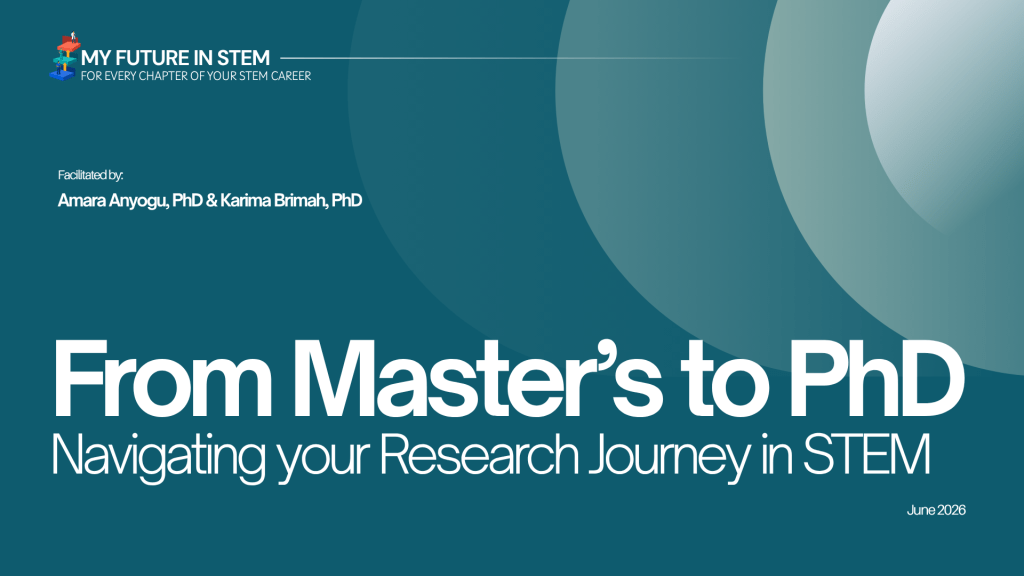
On 24 June 2026, Dr Karima Brimah (University of Westminster) and I co-hosted From Master’s to PhD: Navigating Your Research Journey in STEM. This was a free online panel discussion for postgraduate taught students in STEM (although everyone was welcome). The session was built around a question that Master’s students often carry quietly: Should I do a PhD? and the three follow-on questions that come with it. Should I do a PhD now, a PhD later, or a PhD at all?
We invited four researchers from a range of doctoral routes to speak honestly about their journeys. Our panellists, Safiyah Mohamed, Success Ajayi, Merin Pereira, and Dr Dina Ahmed, represented international and home students, self-funded and fully funded, those who moved straight from their Master’s, and those who returned to research after time elsewhere. This was a conversation without a recruitment agenda; speakers were asked to describe what the journey actually looks like from inside.
This post is my attempt to capture what I am taking away from their ninety minutes, and some of what attendees told us they were taking away, too.
The PhD > The project
An important lightbulb moment came from Success. Master’s students considering PhDs tend to imagine doctoral life as a kind of monastic devotion to a single project. This includes long hours in the lab, with the dataset or the participant pool stripped away. Success made the case that this image is a real loss of opportunity. A PhD is a compendium of knowledge, skills, and experiences that extends well beyond the research question at its centre. Where are you speaking? How are you translating your research, even in its early stages? Whose work are you engaging with that your own project does not strictly require?
What struck me about listening to him was the range of activities he had already taken on alongside his core research, and the deliberateness with which he had undertaken them. Doctoral researchers who treat the PhD as a broader experience, rather than a single project to be completed, tend to leave with more than just a thesis. They leave with a network, a public voice, and a clear sense of what their work means beyond the institution that funded it.
This matters in a particular way for students from widening participation backgrounds, who may not arrive at doctoral study with the same informal network or the same sense of entitlement to take up space in the field. Hearing Success describe his approach was, in effect, a reframing. You do not have to wait until you finish to do the things ‘researchers’ do. You are a researcher already.
Why this PhD? The individuality of the decision
Merin’s contribution turned the question inward. The temptation when considering a PhD is to settle for a generic answer, such as “I want to do a PhD because I love research” or “because it is the next step.” Merin shared a powerful and unforgettable story about what drew her to the problem of microplastic pollution, showing clearly why generic is not enough. A PhD takes three to four years of your life. The why has to be individual, and it has to be connected to this PhD, so this question, this supervisor, this institution, this point in your life, rather than to a generic image of doctoral study. Anyone considering this route needs to think deeply and critically about that second-order question, and the temptation to rush past it is a temptation worth resisting.
The implication is sharper than it first appears. The decision to pursue a PhD is not made at the moment of accepting an offer. It is made at the moment of recognising why this particular opportunity is the right one. That work belongs to the candidate, not to the supervisor or the institution. No one can hand you your why.
Community is part of what makes it possible
Dr Dina Ahmed, who has recently completed her PhD (Congratulations!), spoke about the people who had been part of her journey. This includes those who had encouraged her, given her advice and mentorship, and held space for her when the work was hardest. The point is structural, not sentimental. Whether you are an international student, a home student, the first in your family to take this route, or someone returning to research after time elsewhere, you will need other people. Community is not a soft extra. It is part of what makes the journey possible.
Dina extended this in a practical direction that I had not heard articulated quite so cleanly before. Community, she said, also includes the researchers who have already graduated from the group you are considering. You can find them on LinkedIn. You can read what they are working on now, and where their PhD took them. You can reach out, and most will reply. Their accounts of life inside that group — the working culture, the support during difficult phases, the way disagreements were handled — will tell you things that the supervisor’s own webpage cannot. The community you are looking for begins before you submit your application.
This was, in effect, the bridge to the conversation that followed.
The elephant in the room = Money
This discussion was treated with a directness the topic rarely gets in formal guidance. The PhD, Safiyah said, is like life. If you are receiving a stipend, you have to know what that stipend is, and you have to make a clear-eyed decision about whether you can live within it. The same budgeting discipline that any salaried adult uses applies here. This is the income you will be on for three to four years; so can you build a life that works on it? If you are considering self-funding, the same question applies in a sharper form. Is this something you can afford for the full period?
The panel and the attendees built on the point with practical detail. Several PhD candidates in the room spoke about the opportunities they had taken alongside their studies, including teaching, tutoring, and lab demonstrations, both for income and for experience. Speaking to graduates from the same supervisor’s group was again identified as a way to learn how others had navigated the financial side, what worked, and what they would do differently. This is one of the questions that prospective candidates can bring directly into their cold email conversations with potential supervisors and into the LinkedIn conversations Dina described.
The supervisor fit has to work both ways
When an attendee asked the panel what mattered most in choosing where to do a PhD — the prestige of the institution, the project, or the supervisor — our four speakers were unanimous. The supervisor first, then the project, then the institution. The ranking is not casual. It reflects the lived experience of doctoral study, as the supervisor greatly shapes what your three to four years look like in a way that the institution’s name on the certificate does not. Assessing a potential supervisor is not just about whether you would be a good addition to their group. It is about whether their group is a good fit for you. Safiyah and Dina shared some great tips. Watch how they engage with you in early conversations. Notice how their current students speak about them, formally and informally. Ask about expectations, working style, and what happens during the difficult phases that come with every PhD. The fit has to work in both directions, and the time spent assessing it is rarely wasted.
What attendees told us they were taking
In the closing minutes of the session, we asked attendees to complete two sentences: one thing that changed in my thinking today was and one thing I now plan to do next is.
Two responses stayed with me.
One attendee wrote: “I am now sure I am ready for a PhD; I just need to find the right team and a project that keeps me focused.” Another wrote: “No matter how difficult it gets, I will keep trying.”
The first response is exactly the kind of clarification a session like this should produce, and is a conversation I hope we can have more of in our MSc ‘Research Methods’ modules. It is not a recruitment outcome, but a decision-readiness one. A space was created, and a framework was provided to recognise that the decision they had been weighing was already made, and that the next step is the practical one of finding the right team and project.
The second response speaks to the resilience that runs underneath any honest account of the doctoral journey. It is also evidence that this particular form, honest stories from people still on the path, does something that polished guidance may not.
What comes next
Karima and I sent a follow-up resource pack to every webinar attendee. This includes three short activities to support their decision-making, contacting potential supervisors, etc., all designed to help them turn what they heard into their own next steps. If you would like to receive it, please complete the form below to download it*.
This event was extra special because it was a revival of something we are both passionate and intentional about. The move from Master’s to PhD is one of several transition points where postgraduate and early-career researchers need honest information that is hard to find through formal channels. We are planning further sessions on other transitions, so please watch this space.
Thank you to Safiyah Mohamed, Success Ajayi, Meren Pereira, and Dr Dina Ahmed for their generosity, and to Dr Karima Brimah for co-organising and moderating, which held the session together.
Until the next one!
Post Event Resource
Please complete the form below to access the workbook. By completing this form, you agree to receive a single email from us in a few months asking how you used it and if it helped.
A note on how this resource was made: The activities in this resource are original. This includes the frameworks, questions, and structure, which are ours and developed for this event. We have used GenAI tools as a drafting and editing aid in writing them up, as I do across this site. The resource is shared under a Creative Commons licence, so you’re free to adapt it. A fuller account of how I work with GenAI tools can be found here.


Leave a Reply